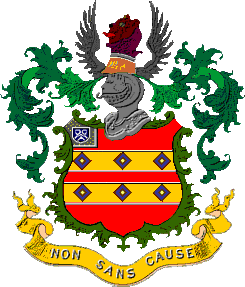
The description recorded on page 393 of Burke's General Armory reads:
Gu. two bars or., each charged with three mascles az. on a canton of the second, a leopard's face of the third:
The interpretation:
A red shield (feeling of bravery, fortitude in military context; represents a fiery nature) with bars of gold (richest of all metals; exceeds all others for courage and valor, purity and high value) each charged with three mascles (an open lozenge where armor is fastened) of azure (blue, representing important traits of fidelity, loyalty and truthfulness) on a canton (rectangle) of the second, a leopard's face (heroism, courage, strength and power; a generous nature of royal and noble bearing) of the third.
(Be cautious when researching family crests, there are disreputable organisations who'll send you a picture of any old crest and tell you it's yours.)